Multivariate interpolation
 |
 |
| Vector | C | |
| in the palette | on the schematic |
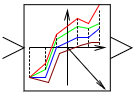
The block allows to implement linear interpolation of a multidimensional table-defined function.
Inputs
- input – the port for interpolated coordinates. A matrix of dimension M by N can be fed to the input, where M is the number of interpolated points, N is the dimension of the interpolated table.
Outputs
- output – the port for interpolated values of functions. At this output, there will be an array of dimension M equal to the number of interpolated points (the number of rows in the array fed to the input).
Properties
- Matrix of arguments by dimensions - a grid of known arguments of the function specified by the matrix [[values of arguments by dimension 1],... [grid values by dimension N]];
- Function value vector - an array of values of a given multidimensional function, at points specified by known arguments. If N=3 and the dimensions x[1], x[2] and x[3] are respectively nx, ny, nz, then the element number (starting from 0) of the function array corresponding to these coordinates is i+nx(j+ny k), where i, j, k are the numbers under which the coordinates in the vectors x[1], x[2] and x[3] stand. For coordinate values that are not table-defined, linear interpolation is performed at adjacent points.
- Interpolation method - the desired method of interpolation: linear between two adjacent points, or stepwise, saving the value of the previous point;
- Extrapolate boundaries is a way to determine the value of a function outside the argument grid.
Parameters
none