BDCM key selector block


in the palette on the schematic

The block implements a logical algorithm for selecting the inverter keys depending on the position of the rotor and the sign of the specified torque.

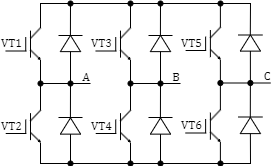
How the output signals of the block and the keys of the three-phase inverter is matching each other, is illustrated in the figure (Figure 1).


Figure 1. Distribution of output signals

Key selection signals are generated by the model depending on the value of the “sign” signal and signals from the RPS in accordance with the table (Table 1).

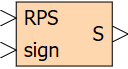
Table 1. Signal-key matching
Field angle 0...30° 30°...90° 90°...150° 150°...210° 210°...270° 270°...330° 330°...0
RPS (3 2 1) 0 0 1 0 1 1 0 1 0 1 1 0 1 0 0 1 0 1 0 0 1
sign = 0

(M > 0)

- S2 S2 - S1 S1 -
S3 S3 - S4 S4 - S3
S6 - S5 S5 - S6 S6
sign = 1

(M < 0)

- S1 S1 - S2 S2 -
S4 S4 - S3 S3 - S4
S5 - S6 S6 - S5 S5
Note:
For detailed description of the model see [1, 2].

Inputs

Name Description Communication line type
RPS Three-channel signal from the rotor position sensor Mathematical
signature Torque sign input Mathematical

Outputs

Name Description Communication line type
S 6-channel signal for selection of the inverter keys Mathematical

Properties

The block has no properties.

Parameters

The block has no parameters.

Examples

Examples of block application:
  • Position of the BDCM

Literature