Translatory friction
 |
 |
| C | |
| in the palette | on the schematic |
The block is designed to simulate the contact friction of two translatory moving surfaces with a constant pressing force.
The relative slip speed v in m/s is determined by the formula:

where vC and vR – linear speeds at ports "C" and "R", respectively, m/s.
The Stribeck curve [1] and viscous friction (Figure 1) are used to determine the friction force.
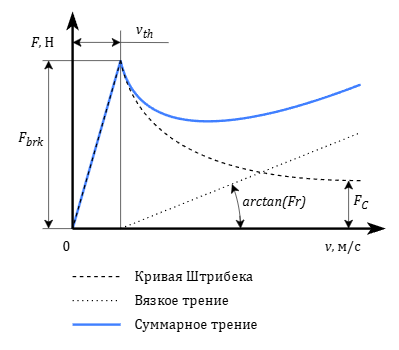
Figure 1. Dependence of friction force on relative speed
The friction force is determined by the formula:


where:
- FC and FC – forces applied to ports "C" and "R", respectively, N
- Fbrk – breakaway friction force, N
- Fc – dry (coulomb) friction force, N
- vth – breakaway speed, m/s
- C – damp ratio, s/m
- Fr – coefficient of internal friction, N·s/m
The value of the breakaway friction force Fbrk, N, is displayed next to the block
Inputs
| Name | Description | Connection line type |
|---|---|---|
| C | Port for connecting a conditionally fixed case (case) | Translatory mechanics |
| R | Port for connecting a conditionally movable rod (rod) | Translatory mechanics |
Outputs
None.
Properties
| Name | Parameter | Description | By default | Data type |
|---|---|---|---|---|
| Breakaway friction force, N | Fbrk | Breakaway friction force | 2 | Вещественное |
| Breakaway speed,m/s | Vth | The threshold value of the speed below which the value of the friction force is reduced to achieve the stability of the numerical solution | 0.001 | Вещественное |
| Dry (coulomb) friction force, N | Fc | Dry (coulomb) friction force | 1 | Вещественное |
| Damp ratio, s/m | C | Damp ratio | 1 | Вещественное |
| Coefficient of internal friction, N·s/m | Fr | Coefficient of internal friction | 0.1 | Вещественное |
Parameters
| Name | Parameter | Description | Data type |
|---|---|---|---|
| Speed differential, m/s | V | Relative slip speed | Вещественное |
| Friction force, N | F | Force at the port "R" | Вещественное |
| Power of friction force, W | Q | Power of friction force, W | Вещественное |
Examples
Examples of block application:
Literature
- Richard Stribeck: Die wesentlichen Eigenschaften der Gleit- und Rollenlager, Z. Verein. Deut. Ing. Vol. 46 Seite 38ff. 1341–1348 (1902).