Variable translatory friction


| C |
in the palette on the schematic

The block is designed to simulate the contact friction of two translatory moving surfaces with a variable pressing force.

The relative slip speed v in m/s is determined by the formula:

where vC and vR – linear speeds at ports "C" and "R", respectively, m/s.

Defining the friction curve is possible in two ways: the Stribeck curve and the tabulated curve.

Stribek curve

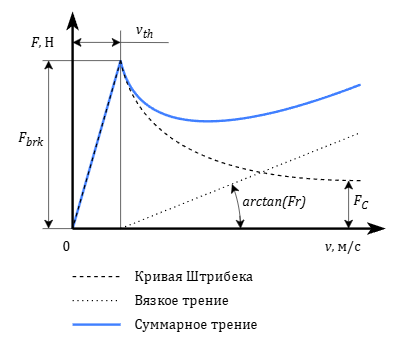
When using this method, the Stribeck friction curve [1] and viscous friction (Figure 1) are used to determine the friction force.


Figure 1. Dependence of friction force on relative speed
The friction force is determined by the formula:


where:
  • FC and FC – forces applied to ports "C" and "R", respectively, N
  • Fbrk – breakaway friction force, N
  • Fc – dry (coulomb) friction force, N
  • vth – breakaway speed, m/s
  • C – damp ratio, s/m
  • Fr – factor of internal friction, N·s/m
Friction forces Fbrk and Fc are calculated depending on the value of the pressing force according to the formulas:


where:
  • N – pressing force, N
  • μ – breakaway friction factor
  • μs – dry (coulomb) friction factor

Tabulated curve

Using this method the friction factor is defined by interpolating a given table. If the slip speed exceeds the value specified in the table, extrapolation is not carried out.

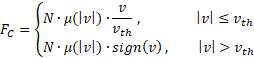
The friction force is determined by the formula:


where μ(|v|) – friction factor value obtained as a result of interpolation.

Inputs

Name Description Connection line type
C Port for connecting a conditionally fixed case (case) Translatory mechanics
R Port for connecting a conditionally movable rod (rod) Translatory mechanics
N Specified pressing force Mathematical

Outputs

None.

Properties

Title Parameter Description By default Data type
Friction curve A group of properties that define the friction parameters
Friction model MType Friction model type The possible values are: "Stribek curve", "Tabulated curve Stribek curve Перечисление
Breakaway friction factor Mu Breakaway friction factor. The property is available when selecting the model defining method as "Stribek curve" 0.3 Вещественное
Dry (coulomb) friction factor Mus Dry (coulomb) friction factor. The property is available when selecting the model defining method as "Stribek curve" 0.15 Вещественное
Damp ratio, s/m C Damp ratio. The property is available when selecting the model defining method as "Stribek curve" 1 Вещественное
Coefficient of internal friction, N·s/m Fr Coefficient of internal friction. The property is available when selecting the model defining method as "Stribek curve" 0.1 Вещественное
Array of speeds, m/s Vx Array of slip speed values. The property is available when selecting the model defining method as "Tabulated curve" [0 , 0.1 , 0.2 , 0.3 , 0.4 , 0.5 , 1 , 2 , 5] Массив
Array of friction factors My Array of friction factor values. The property is available when selecting the model defining method as "Tabulated curve" [0.29 , 0.28 , 0.26 , 0.22 , 0.21 , 0.2 , 0.2 , 0.19 , 0.19] Массив
Breakaway speed,​m/s Vth The threshold value of the speed below which the value of the friction force is reduced to achieve the stability of the numerical solution 0.001 Вещественное
Maximum pressing force, N Pth The maximum pressing force limiting the value of defining pressing force 1000 Вещественное

Parameters

Name Parameter Description Data type
Speed differential, m/s V Relative slip speed Вещественное
Friction force, N F Force at the port "R" Вещественное
Power of friction force, W Q Power of friction force, W Вещественное

Examples

Examples of block application:

Literature

  1. Richard Stribeck: Die wesentlichen Eigenschaften der Gleit- und Rollenlager, Z. Verein. Deut. Ing. Vol. 46 Seite 38ff. 1341–1348 (1902).