Key-0
 |
 |
| Vector | C | ST | |
| in the palette | on the schematic |
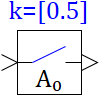
The block is vectorized and implements the controlled key function according to the following algorithm:
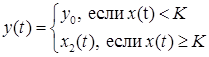
where x(t) is the vector of input signals, y(t) is the vector of output signals, K is the vector of “thresholds” (setpoint parameters), y0 is the vector of block output signals at input signals less than threshold values.
where x(t) is the vector of input signals, y(t) is the vector of output signals, K is the vector of “thresholds” (setpoint parameters), y0 is the vector of block output signals at input signals less than threshold values.
Inputs
- input - the block input, x;
Outputs
- output - the block output, y;
Properties
- Setpoint — the vector of "thresholds" K;
- Subthreshold value — the vector of the output signals of the block y0 (with input signals less than the threshold values).
Parameters
- Level - the current position of the key.
Note:
- By default, the block generates a scalar output signal.
- Named properties can be set as local model variables (submodels) in a programming language script, as global project signals using the Tools → Signals main menu item, or as external project signals using an attachable signal database.