Key-6(t)
 |
 |
| Vector | |
| in the palette | on the schematic |
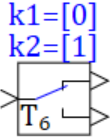
The block implements the function of the controlled key according to the following algorithm:
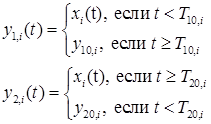
where x(t) is the vector of input signals, y1(t), y2(t) are the vectors of output signals on the 1st and 2nd output ports; y10 is the vector of output signals on the 1st output port at t ≥ T10; y20 is the vector of output signals on the 2nd output port at t < T20.
where x(t) is the vector of input signals, y1(t), y2(t) are the vectors of output signals on the 1st and 2nd output ports; y10 is the vector of output signals on the 1st output port at t ≥ T10; y20 is the vector of output signals on the 2nd output port at t < T20.
Inputs
- input - the block input, x;
Outputs
- output1 - the first block output, y1;
- output2 - the second block output, y2;
Properties
- The first output setpoint is vector T10.
- The second output setpoint is vector T20.
- The initial value of the 1st output is the vector y10.
- The initial value of the 2nd output is the vector y20.
Parameters
- Level - the current position of the key.
Note:
- By default, the block generates a scalar output signal.
- Named properties can be set as local model variables (submodels) in a programming language script, as global project signals using the Tools → Signals main menu item, or as external project signals using an attachable signal database.