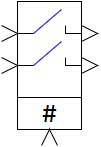
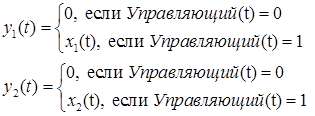
The block implements the function of the controlled key according to the following algorithm:
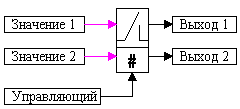
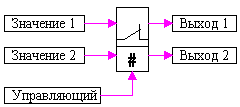
where x1(t), x2(t) are the input signals of the block (or signal vectors), y1(t), y2(t) are the output signals of the block (or signal vector). The control signal enters the unit from above. During the calculation process the block image changes depending on the presence of the control signal: in normal position the key is open, i.e. when the control signal is applied the key is closed:
Figure 1. Control signal = 0
Figure 2. Control signal = 1The block is a submodel (assembly). To view the structure of the algorithm, right-click Actions → Enter to the submodel.
Inputs
Control - switching control signal;
Value1 - the first input signal of the unit, x1;
Value2 is the second input signal of the block x2.
Outputs
output 1 - the first block output, y1;
output 2 - the second block output, y2.
Properties
none
Parameters
none
Note:
By default, the block generates a scalar output signal.
Since the key algorithm (in the submodel) is implemented using Multiplier blocks, when a control signal other than 1 is applied, the output of the block will have signals equal to the product of xi(t) multiplication by the value of the control signal.