Pulse function
 |
 |
| Vector | |
| in the palette | on the schematic |
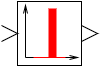
The block returns a pulse of a set duration at the output when the specified condition is met at the input of the block. The pulse amplitude is:

where τi is the pulse duration for the i-th element of the output vector, yi(t) is the element of the output vector signal. Thus, the integral of a pulse value (for a time equal to its duration) is equal to one.
where τi is the pulse duration for the i-th element of the output vector, yi(t) is the element of the output vector signal. Thus, the integral of a pulse value (for a time equal to its duration) is equal to one.
Inputs
- input - input signal.
Outputs
- output - output pulse signal.
Properties
- Triggering condition – a condition under which an impulse is formed at the output. Variants of the condition: the input is changed, the input is increasing, the input is decreasing, the input is non-zero.
- Pulse duration vector is the pulse duration vector τ=[τ1, τ2, …, τn] for each element of the output vector.
- Neutral condition value vector – values of output elements when the condition is not met.
Parameters
none
Note:
by default the block implements a pulse function for a scalar input signal.