Memorizing signal values
 |
 |
| Vector | C | |
| in the palette | on the schematic |
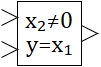
The block saves the signal (s) according to the following algorithm:

where x1,i(t), x2,i(t) are the i-th elements of the first and second vector input signals, yi(t) is the i-th element of the vector output signal. In other words, if a non-zero signal is applied to the second input, then the value of the signal at the output is equal to the value of the signal at the first input. At a zero signal at the second input, the block "memorizes" the value of the first input and then the output does not change (until a positive signal is fed to the second input again).
where x1,i(t), x2,i(t) are the i-th elements of the first and second vector input signals, yi(t) is the i-th element of the vector output signal. In other words, if a non-zero signal is applied to the second input, then the value of the signal at the output is equal to the value of the signal at the first input. At a zero signal at the second input, the block "memorizes" the value of the first input and then the output does not change (until a positive signal is fed to the second input again).
Inputs
- input - input signal;
- control - input control signal.
Outputs
- output - output signal.
Properties
none
Parameters
none